
Key takeaways
- The MLTS location gap is now on the federal record, and it showed up at Phase 1. During Phase 1 connectivity testing in Massachusetts, Verizon found that 911 calls from multi-line telephone system (MLTS) customers on third-party Private Switch ALI (PS-ALI) were going to a national call center instead of the state’s NGCS provider, because Verizon didn’t have their location. DA 26-1043 is the FCC Public Safety and Homeland Security Bureau’s attempt to help other carriers find the gap before cutover.
- Carriers are now on notice to go get the data. The Bureau advised every wireline originating service provider to find its MLTS customers on third-party PS-ALI and start collecting their location, before a valid request arrives. It also said an enterprise can’t be expected to comply if its carrier hasn’t given it a way to send location in.
- The links between the parties are still missing. The notice is guidance, not a new rule. It doesn’t define the solution a carrier owes, set an update interval, say who pays to convert PS-ALI records, or address the vendors in the middle. Those remain contract questions.
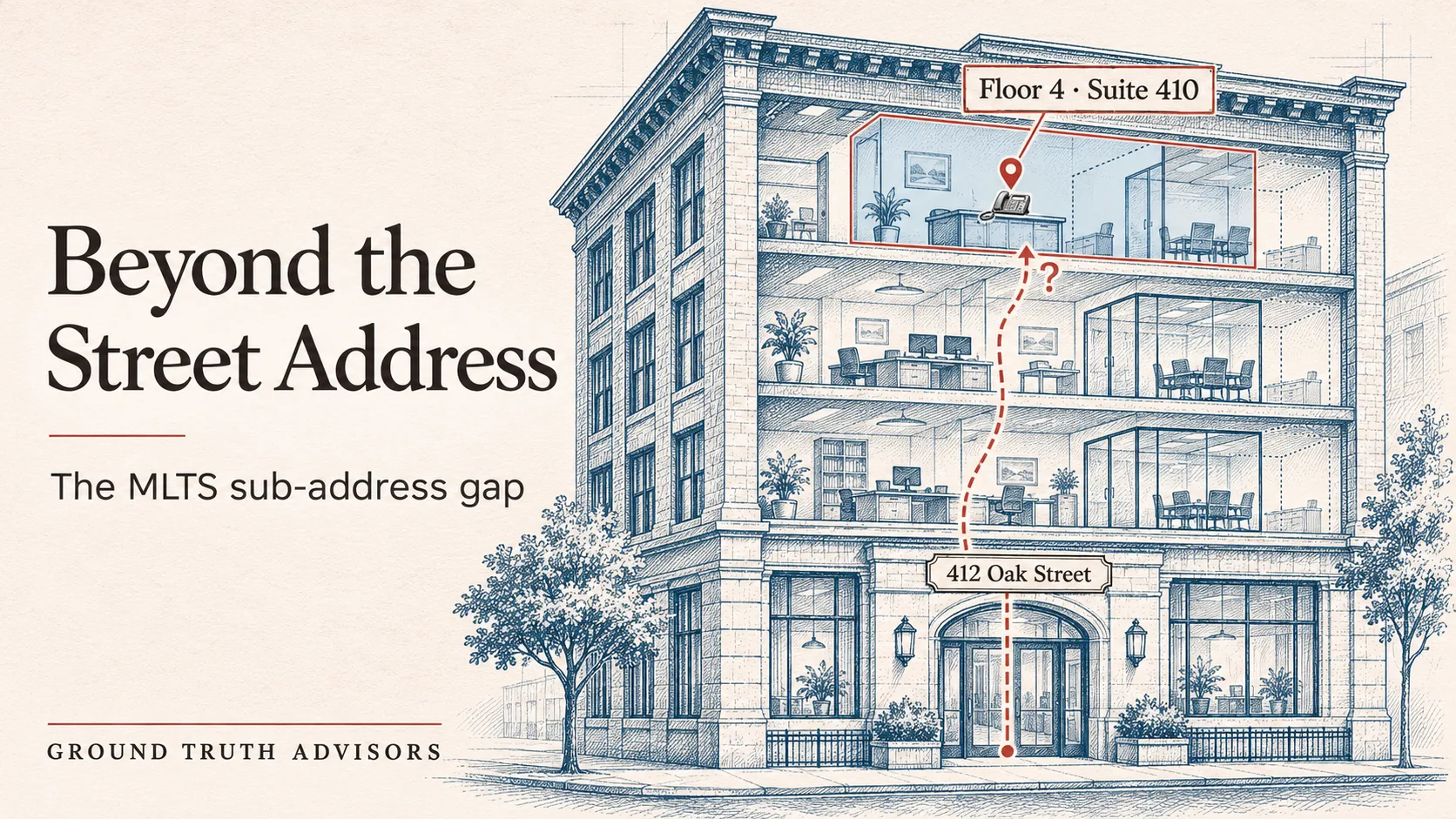
The last post in this series, Who Owns the LIS?, asked who is responsible for the Location Information Server (LIS). Under 47 CFR Part 9, Subpart J, the answer is clear once a 911 Authority serves a Phase 2 valid request: the LIS is the originating service provider’s responsibility, and so is the cost. What the rules don’t settle is how the location record gets from the enterprise running the phone system to the carrier.
On September 28, 2026, the FCC’s Public Safety and Homeland Security Bureau weighed in on that part. It released two documents together. The first was an order granting Verizon a limited waiver of its NG911 Phase 1 obligations, subject to conditions (DA 26-1042). The second was a Public Notice, DA 26-1043, written so the rest of the industry could learn from what Verizon found.
What Verizon found is the problem this series has been describing: a location record that starts with the enterprise running the phone system, a carrier that answers for delivering the call, and nothing in the rules that connects the two. Who Owns the LIS? called it case three. Massachusetts showed that case three isn’t only a VoIP problem.
What happened in Massachusetts
Verizon’s petition, filed April 17, 2026, asked for more time to implement Phase 1 in Massachusetts and other jurisdictions. During connectivity testing for its wireline Phase 1 cutover, Verizon discovered that 911 calls from MLTS customers using PS-ALI were being delivered to a national call center rather than directly to the Massachusetts NGCS provider.
Verizon traced the problem to Time Division Multiplexing (TDM) customers using third-party PS-ALI services. It didn’t have the location information for those customers. It started collecting that location from its MLTS customers, and the waiver order gives it additional time to finish its PS-ALI solution and reach them.
The notice doesn’t lay out the mechanics, but NENA’s Private Switch (PS) E-9-1-1 Database Standard (NENA 06-003) describes the arrangement. PS-ALI gives each MLTS station its own record in the 911 ALI database, and keeping those records current is the MLTS owner or operator’s responsibility. The operator can send records to its telephone service provider, to the database provider, or to a third-party provider that validates them and passes them on. On that third-party path, the record reaches the ALI database without the carrier holding it. The notice doesn’t explain why that surfaced at Phase 1; it says only that Verizon didn’t have the location.
What the Bureau is telling each party
The waiver is limited to Verizon’s facts. The Public Notice isn’t; it’s addressed to everyone.
Wireline originating service providers (OSPs). The comment record suggests other wireline carriers may hit the same issue, so the Bureau considers all of them “on notice.” Even before receiving a Phase 1 or Phase 2 request, they should examine whether they have MLTS customers on third-party PS-ALI and begin obtaining location for them. Then the line that matters most: “MLTS enterprises cannot be expected to support NG911 call routing and provide caller location information if the OSP has not provided an NG911 routing solution that enables its MLTS customers to deliver the required location information to the OSP.”
MLTS operators and managers. Those on wireline TDM with third-party PS-ALI should work with their carriers. Under the Kari’s Law and RAY BAUM’S Act rules (47 CFR §§ 9.15-9.17), they have to provide location with every MLTS-originated 911 call, and the Bureau notes they “may be the only entities that have this information.” Where a service provider acts only as a conduit and doesn’t operate or manage the MLTS, the MLTS entity carries the obligation.
Everyone still on TDM. The Bureau encourages TDM-based MLTS users to move to IP so they aren’t “left behind,” and encourages carriers to offer incentives for it.
Phase 1 and Phase 2 generally. Four reminders:
- Carriers pay to deliver. OSPs are presumptively responsible for the cost of getting 911 traffic to the NG911 Delivery Points a 911 Authority designates, absent an alternative arrangement with the 911 Authority. They are also potentially liable for their share of any 911 Authority-owned circuits they use to get there.
- PSAP readiness isn’t a precondition. The 911 Authority has to be ready to receive traffic. Individual PSAPs, including their call handling equipment, don’t. The 911 Authority can deliver to PSAPs that aren’t NG911-ready through a Legacy PSAP Gateway.
- Say something early. Some carriers haven’t told 911 Authorities they’d miss a deadline. The North Central Texas Emergency Communications District told the FCC that “several carriers have failed to meet the Phase 1 deadline and have not requested an extension.”
- Use mutual agreements. 911 Authorities and carriers can extend deadlines by agreement when circumstances warrant, and a Phase 1 extension should also say what happens to Phase 2 dates.
Where it lines up with the first two posts
Case three isn’t only a VoIP problem. Who Owns the LIS? described MLTS on top of a VoIP Positioning Center (VPC) as the hardest of three starting positions for a carrier, because the record the carrier needs originates with somebody else. Verizon’s Massachusetts customers were on wireline TDM, not VoIP, but the problem was the same: the location record sat with the enterprise and its PS-ALI provider, not with the carrier. The waiver proceeding puts that on the federal record.
The record starts with the MLTS operator. That post argued the room number originates with whoever administers the phone system under § 9.16. The Bureau now says the same thing in its own words: the operators “may be the only entities that have this information.”
The carrier still carries the cost. Who Owns the LIS? pointed to § 9.33 for who pays to obtain and deliver location. The notice restates the same presumption for transport, citing the 2024 NG911 Transition Order (FCC 24-78).
Collecting a record isn’t validating it. Four Boxes, One Map made the point that a location record has to be built the way the GIS behind the Location Validation Function (LVF) is built, using the Civic Location Data Exchange Format (CLDXF), or it can’t be validated. The records Verizon and other carriers are now collecting will have to be verified through a LIS at Phase 2 (§ 9.29(b)(3)) and delivered in the NG911 commonly accepted standards the 911 Authority identifies. Where that standard is NENA i3, verification means clearing the LVF. Getting them in hand is the first step, not the last.
Where it changes what I wrote
It’s a Phase 1 problem too. I framed the MLTS gap around Phase 2, because that’s when § 9.29(b) puts the LIS on the carrier. For carriers with MLTS customers on third-party PS-ALI, the gap shows up a phase earlier, during Phase 1 connectivity testing. That makes it more urgent for 911 Authorities, not less.
Carriers are expected to go upstream. Who Owns the LIS? said the OSP “has no obligation to go back to the MLTS operator or its vendor and get the source corrected.” As a statement of the rules, that’s still accurate; the notice advises rather than requires. As a statement of what the Bureau expects, it isn’t anymore. The Bureau has advised carriers to find these customers and start collecting their location, and it has tied the enterprise’s ability to comply to the carrier providing a way in. The dependency I described as running one direction now runs both.
The chain has more links than I drew. The Bureau cites two points from the 2019 Kari’s Law and RAY BAUM’S Act order that I should have used. One is that MLTS managers and operators may rely on their enterprise customers to acquire, maintain, and update location. That puts a fourth party in the chain when someone other than the enterprise manages the system. The other is the conduit line above, which partly answers my point that no rule divides the manager-or-operator role. It settles the case where the provider only carries traffic. It doesn’t settle hosted PBX, where the provider runs the platform and the customer assigns the extensions.
What’s still open
What the carrier’s solution has to be. The notice says carriers need an “NG911 routing solution” that lets MLTS customers deliver location. The notice doesn’t define one. NENA's IP-Based MLTS Considerations Working Group, which the Bureau cites, is developing vendor-neutral configuration guidance and reference architectures for MLTS operators.
How the record stays current. The notice is about getting location at all. It doesn’t set an update interval or a synchronization mechanism, so the third-floor phone that moved to the first floor eight months ago is exactly as exposed as it was last week.
Who pays for the conversion. Moving a PS-ALI record into a HELD and PIDF-LO exchange a carrier can stand behind is real work on both sides. Section 9.33 covers the carrier’s cost to obtain and deliver location; the enterprise’s side, and any vendor charges in between, aren’t addressed.
The vendors in the middle. Under NENA 06-003, third-party PS-ALI providers validate and manage the enterprise’s records and pass them to the 911 database provider, while the MLTS operator stays responsible for keeping them current. The notice doesn’t address what those providers owe.
IP-based and hosted MLTS. The guidance is aimed at TDM systems. A cloud PBX on an interconnected VoIP carrier has its own version of this problem, and the notice doesn’t speak to it.
What each side can do now
911 Authorities. Ask each wireline carrier whether it has inventoried MLTS customers on third-party PS-ALI, and where those calls will route at cutover. Put MLTS test calls into your Phase 1 connectivity testing. If you negotiate an extension, write MLTS milestones and the Phase 2 dates into the agreement.
Originating service providers. Inventory now, before a request arrives. If it turns up a problem, tell the 911 Authority and its NGCS provider early; the North Central Texas letter shows 911 Authorities notice when carriers don’t. Define the intake path for MLTS location: the format, the LVF validation step, and what triggers an update.
MLTS operators and their vendors. Call your carrier and ask what it’s offering. Your § 9.16 obligation doesn’t wait on theirs. If you’re still on TDM, start planning the move.
Bottom line
DA 26-1043 confirms that the MLTS location gap is real, that it arrives earlier than the rules suggest, and that the Bureau expects carriers to help close it. The rule and the burden sit with different parties: the carrier owns the LIS, and the enterprise owns the data that has to go in it. The notice doesn’t connect the parties. That work still has to happen in contracts, and most weren’t written with it in mind.
Frequently asked questions
What is FCC DA 26-1043?
DA 26-1043 is a Public Notice released September 28, 2026, by the FCC’s Public Safety and Homeland Security Bureau. It gives guidance on Next Generation 911 (NG911) implementation for multi-line telephone systems (MLTS), originating service providers, NGCS providers, and 911 Authorities. It was released as a companion to DA 26-1042, an order granting Verizon a limited waiver of its Phase 1 obligations, subject to conditions. The notice advises wireline carriers to find MLTS customers using third-party Private Switch ALI (PS-ALI) and begin collecting their location, and it restates carrier cost and deadline responsibilities for Phase 1 and Phase 2.
What happened with Verizon’s MLTS 911 calls in Massachusetts?
During connectivity testing for its wireline Phase 1 implementation, Verizon found that 911 calls from MLTS customers using third-party Private Switch ALI (PS-ALI) services were going to a national call center instead of directly to the Massachusetts NGCS provider. Verizon traced it to Time Division Multiplexing (TDM) customers whose location information it didn’t have. It began collecting location from those customers, and in DA 26-1042 the FCC’s Public Safety and Homeland Security Bureau granted a limited waiver, subject to conditions, giving Verizon more time to implement its PS-ALI solution and reach its MLTS customers.
Do carriers have to collect location from MLTS customers for NG911?
DA 26-1043 advises it rather than creating a new rule. The FCC’s Public Safety and Homeland Security Bureau put all wireline originating service providers (OSPs) “on notice” to examine whether they have multi-line telephone system (MLTS) customers using third-party PS-ALI and to begin obtaining their location, even before a Phase 1 or Phase 2 request. It also said MLTS enterprises can’t be expected to provide location for NG911 routing if the OSP hasn’t provided a solution that lets them deliver it. Separately, MLTS operators and managers must convey location under 47 CFR § 9.16.
Does a PSAP need to be NG911-ready before a 911 Authority serves a Phase 1 request?
No. The 911 Authority must be ready to receive 911 traffic in the requested format, but individual public safety answering points (PSAPs), including their call handling equipment, don’t have to be NG911-ready first. DA 26-1043 restates this from the FCC’s 2024 NG911 Transition Order (FCC 24-78). The 911 Authority is responsible for delivering calls to PSAPs connected to the Emergency Services IP Network (ESInet), and it can use a Legacy PSAP Gateway to reach PSAPs still on legacy call handling equipment.
This article is part of the NG9-1-1 location series. Start with Four Boxes, One Map. Previous: Who Owns the LIS? For terms used here, see the NG9-1-1 & GIS glossary.
If you’re a carrier working through an MLTS inventory, or a 911 Authority deciding how to test for it, I’d like to hear how it’s going.
Next in the minimum viable data series: what a 911 authority can and can’t validate inside private buildings.
Sources
- FCC Public Safety and Homeland Security Bureau, Public Safety and Homeland Security Bureau Provides Guidance on Implementation of Next Generation 911 (NG911) for Multi-Line Telephone Systems (MLTS) and Other Public Safety Stakeholders, Public Notice, DA 26-1043, PS Docket Nos. 21-479, 18-261 (Sept. 28, 2026)
- Facilitating Implementation of Next Generation 911 Services (NG911), PS Docket No. 21-479, Order, DA 26-1042 (PSHSB 2026) (Verizon Waiver Order), https://docs.fcc.gov/public/attachments/DA-26-1042A1.pdf
- Verizon, Petition for Waiver, PS Docket No. 21-479 (filed Apr. 17, 2026), https://www.fcc.gov/ecfs/search/search-filings/filing/10417519901088
- Letter from Christy L. Williams, Director, North Central Texas Emergency Communications District, to Marlene H. Dortch, Secretary, FCC, PS Docket No. 21-479, Attach. at 6 (filed May 1, 2026)
- Implementing Kari’s Law and Section 506 of RAY BAUM’S Act, PS Docket Nos. 18-261 and 17-239, GN Docket No. 11-117, Report and Order, FCC 19-76, 34 FCC Rcd 6607 (2019)
- FCC 24-78, Facilitating Implementation of Next Generation 911 Services (NG911); Location-Based Routing for Wireless 911 Calls, PS Docket Nos. 21-479, 18-64, Report and Order, 39 FCC Rcd 8137 (2024)
- 47 CFR §§ 9.15-9.17: Multi-line telephone systems
- 47 CFR § 9.29: Next Generation 911 transition requirements
- 47 CFR § 9.33: Cost responsibilities
- NENA, Volunteers Sought for IP-Based MLTS Considerations Working Group (Sept. 16, 2025), https://www.nena.org/news/710247/Volunteers-Sought-for-IP-Based-MLTS-Considerations-Working-Group.htm
- NENA, Private Switch (PS) E-9-1-1 Database Standard, NENA 06-003
- NENA, NENA Next Generation 9-1-1 United States Civic Location Data Exchange Format (CLDXF-US) Standard, NENA-STA-004.2-2024
- NENA, NENA i3 Standard for Next Generation 9-1-1, NENA-STA-010.3f-2021